
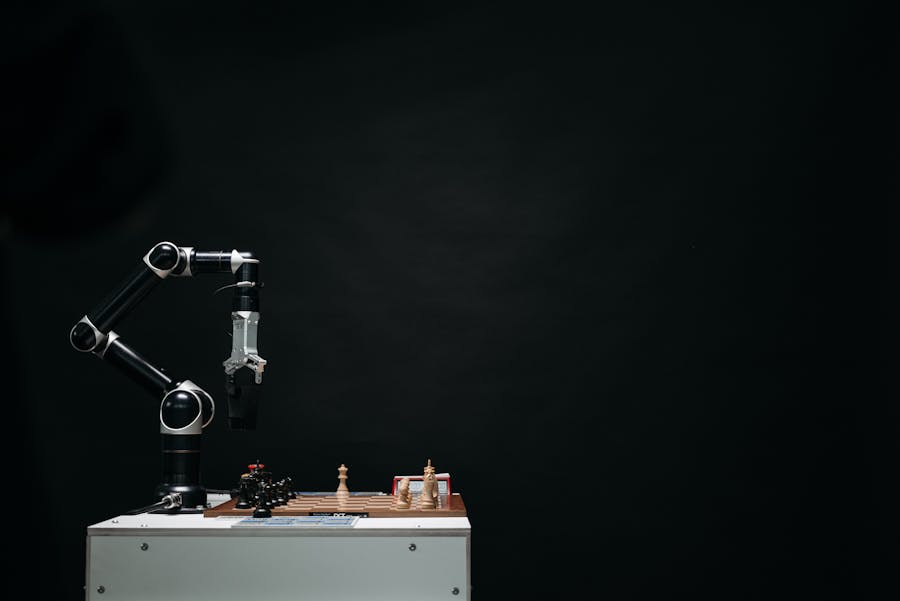
Technology in which software, sensors and machines work together
What is robotics and what are robots?
Robotics is the field concerned with developing, programming and applying robots. This brings together software and physical technology. A robot can receive information from its environment, process it and then carry out a predetermined action.
- 01Robotics
- 02Software
- 03Sensors
- 04Automation
Software makes physical systems respond
What is robotics?
Robotics is applied in various environments, from production and logistics to healthcare, research and services. Which technique is needed depends on the task the robot must carry out.
Robotics is about machines that can carry out actions based on software and available information. Sensors can, for example, register distance, position, movement, pressure or other values. The software processes this input and determines which action is then carried out.
A robot can perform a simple repetitive task, but can also be part of an extensive system in which various sensors, devices and software components work together. The technical possibilities are determined by the hardware, software and the desired application.

Collaboration
Your course, our craft
You know your organisation, your processes and your users best. That is why you make the functional choices, and we make sure the technology fits them seamlessly. We are happy to think along, while you stay in charge.
Where you set the direction
- Your business strategy and how IT supports it
- Standard software or custom build: what fits best
- Package choices and how your processes map onto them
- The functional requirements for the custom build
- Which data needs to move to the new system
- Rollout and training of your users
Where we deliver the technology
- Technical specification of the custom build
- Software development
- Testing and quality assurance (QA)
- Software security
- Technical execution of the data conversion
- Hosting and monitoring
Clear roles, one shared result
Machines that perform programmed tasks
What exactly are robots?
What are robots? Robots are programmable machines that can perform physical actions. Some robots operate largely automatically, while others are controlled directly by a user or respond to specific commands.
Not every robot looks like a human. Industrial robot arms, mobile warehouse robots, inspection robots and care robots can all fall under robotics. The form is mainly determined by what the machine needs to be able to do.
Software forms an important part of this. It determines, for example, how a robot responds to sensor data, which movement is carried out and under which conditions a particular action may take place.
Observing, processing and executing
How does a robot work?
Many robots work according to a technical process in which information is first gathered. A camera can supply images, a distance sensor can detect an obstacle and an encoder can indicate how far a motor has rotated.
This data is processed by software. Based on programmed rules, a motor, robotic arm, gripper or other component can then be controlled.
In addition, robots can communicate with other digital systems. A robot in a warehouse, for example, can receive instructions from business software or send back a status after completing a task.
This allows robotics to become part of a broader software environment in which machines and applications exchange data with each other.
From industry to healthcare and logistics
Where is robotics applied?
Robotics can be used for work that needs to be carried out repeatedly, precisely or at specific locations. In production environments, for example, robots can move, position or process parts.
In logistics, mobile robots can transport goods or support warehouse activities. Other applications can be found in inspection, agriculture, research, services and medical technology.
The level of automation also varies. A robot can operate entirely according to pre-set instructions, but a system may also require operation by a user.
This means robotics is not a single technology or application. It is a combination of hardware, software and control systems that can be built up for various technical purposes.
The digital control behind the movement
Which software do robots use?
Robot software determines how a robot processes information and responds to events. The software can, for example, receive commands, read sensor data, control movements and return information to other systems.
Depending on the application, APIs, databases, dashboards or business software may also be part of the technical environment surrounding a robot.
With custom robotics, software can be developed for specific hardware and functions. The required technical implementation is then based on the robot's characteristics, available interfaces and the client's functional specifications.
APPelit can be deployed for the development of software components required within such technical applications.

Information security
Secure by design. Demonstrably.
Do you work with personal or healthcare data? Then you want to be sure that your software partner handles information carefully. APPelit is ISO 27001- and NEN 7510-certified.
ISO 27001
The international standard for information security. Risks, access and incidents are recorded in a management system that is periodically assessed.
NEN 7510
The Dutch standard for information security in healthcare. Important when your software works with medical or health data.
- Security requirements included from the very first specification
- Test cases that align with recorded security requirements
- AI functions also fall within the same data agreements
Contact
Discuss your question
Leave your details. Within 24 hours, a specialist will contact you for an introductory meeting.